Every parent eventually asks the same question:
How do I prepare my child for the future?
And today, that question has become more difficult-and more important.
Artificial Intelligence is changing how we learn, work, communicate and solve problems. Children growing up today may enter careers that don’t even exist yet. So parents naturally wonder:
* What skills does my child need for the future?
* Will academics alone be enough?
* Should my child learn coding and AI?
* What are the most important life skills for children?
* How can I prepare my child for future careers?
* Which skills will still matter in an AI-powered world?
* When should my child start learning future-ready skills?
The answer isn’t simply more tuition, more technology or more extracurricular activities.
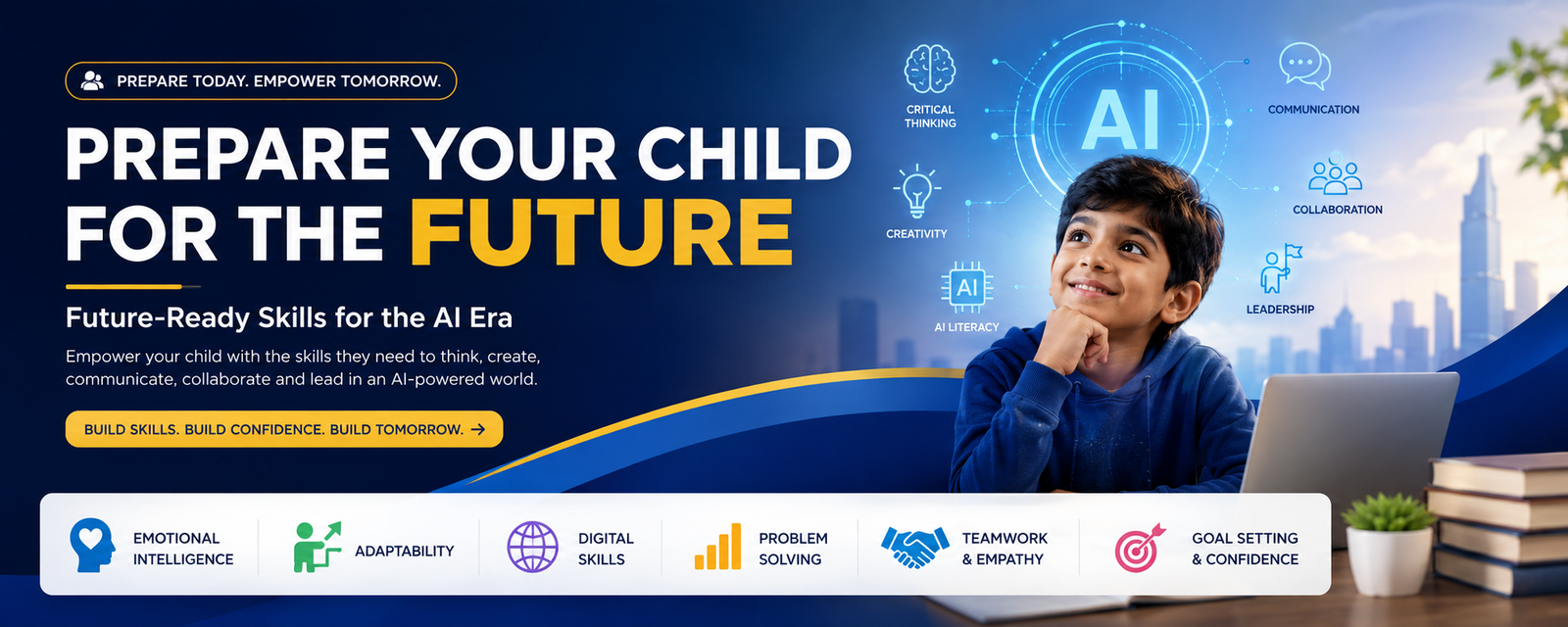
The real goal is to develop a child who can think, communicate, create, collaborate, adapt and lead—while also knowing how to use AI intelligently.
What Does It Mean to Be Future-Ready?
Being future-ready doesn’t mean predicting exactly what career your child will have.
It means giving your child the ability to learn continuously, solve unfamiliar problems, communicate ideas, work with others and adapt when the world changes.
A future-ready child isn’t necessarily the child who knows the most.
It is the child who can say:
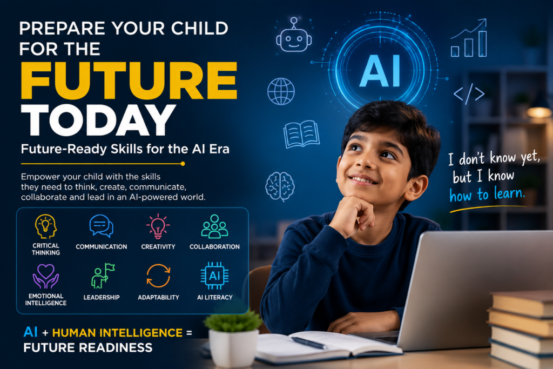
“I don’t know yet—but I know how to learn.”
That mindset can become one of the greatest advantages a child carries into adulthood.
Will AI Replace the Skills Children Learn Today?
AI is becoming increasingly capable of generating information, analysing data, automating repetitive tasks and assisting with creative and professional work.
But this doesn’t mean children should compete with AI.
Instead, they need to learn how to work with technology while strengthening the human capabilities that technology cannot easily replicate.
This is where Human Intelligence becomes increasingly important.
Children need opportunities to develop:
1. Critical Thinking
Children should learn to ask:
Why? How do we know? What could be different?
Critical thinking helps children evaluate information, question assumptions and make thoughtful decisions.
In an age where AI can generate an answer in seconds, knowing whether that answer is accurate, useful or appropriate becomes extremely valuable.
2. Communication Skills
Having a great idea isn’t enough.
Children need to be able to explain it, present it, discuss it and defend it.
Public speaking, listening, storytelling, presentation skills and confident communication can help children participate effectively in classrooms, teams and eventually workplaces.
3. Creativity
The future needs children who can go beyond finding answers.
They need to ask:
“What if?”
Creativity enables children to imagine possibilities, develop new ideas and approach problems from different perspectives.
AI can generate possibilities-but children still need to develop the judgment and imagination to decide which possibilities are worth pursuing.
4. Collaboration
The workplace of the future will not be purely human or purely technological.
People will increasingly work alongside:
* AI tools
* digital platforms
* global teams
* diverse communities
* intelligent systems
Children therefore need to learn how to listen, share responsibility, resolve disagreements and contribute to a team.
5. Emotional Intelligence
A child’s ability to understand emotions, manage reactions, show empathy and build relationships is a fundamental part of being human.
Academic achievement matters.
But so does knowing how to handle failure, disagreement, pressure and change.
6. Leadership
Leadership isn’t only about becoming a CEO.
A child demonstrates leadership when they:
* take initiative
* make responsible decisions
* solve problems
* help others
* take ownership
* speak up respectfully
These are capabilities that can be developed gradually through everyday experiences.
7. Adaptability
Perhaps one of the most important future skills is the ability to adapt.
The knowledge children learn at 10 may not be enough when they are 25.
They will need to continually:
Learn → Unlearn → Relearn.
Education should therefore teach children not only what to know, but how to keep learning.
8. AI Literacy
Preparing children for the future doesn’t mean keeping technology away from them.
It means helping them understand it responsibly.
Children should gradually learn how AI works, what it can and cannot do, how to question AI-generated information, and how to use AI as a tool for learning and creating—not simply consuming.
What Skills Does My Child Need for the Future?

A strong future-readiness foundation can be built around two complementary areas:
ARTIFICIAL INTELLIGENCE
AI literacy • Digital skills • Technology • Computational thinking • Data awareness
HUMAN INTELLIGENCE
Critical thinking • Communication • Creativity • Collaboration • Emotional intelligence • Leadership • Adaptability
Together, they create something more powerful:
Should Children Focus More on Academics or Skills?
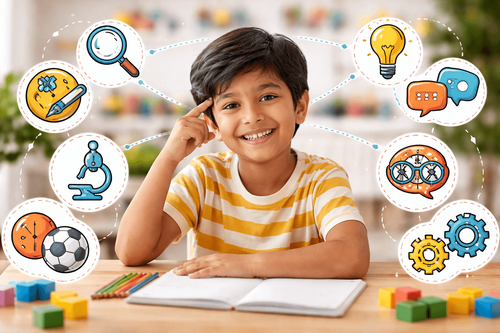
It doesn’t have to be either-or.
Academic knowledge provides the foundation.
Future-ready skills help children apply that knowledge.
A child may know the answer to a question.
But can they:
- explain it?
- question it?
- apply it to a new problem?
- work with someone else to solve it?
- present their solution confidently?
- use technology responsibly to improve it?
That’s where skill development becomes important.
When Should Parents Start Developing Future Skills?
Parents don’t need to wait until secondary school or university.
Future-ready skills can be developed gradually from childhood through age-appropriate activities, projects, discussions, presentations, problem-solving challenges, teamwork and real-world experiences.
The goal isn’t to make children career-focused at a young age.
It’s to build capabilities before they need them.
Because by the time a child is choosing a career, many of their foundational habits-how they communicate, solve problems, respond to challenges and learn-are already developing.
part of our great community. Our community is committed, accepting, and welcoming to experienced and new-coming yoga enthusiasts alike! We specialize in classes anyone of any physical ability and experience can participate in. We are happy to support everyone through their journeys.
Don’t Prepare Your Child for One Job. Prepare Them for Change.
One of the biggest mistakes parents can make is trying to predict the exact career their child should prepare for.
Instead of asking:
“Which career should my child prepare for?”
consider asking:
“Which capabilities will help my child succeed in many different careers?”
That shift changes everything.
Because the future may belong to careers we cannot yet name.
But we already know the kind of person who will be better prepared for that future:
- A curious thinker.
- A confident communicator.
- A creative problem-solver.
- A collaborative team member.
- An adaptable learner.
- A responsible leader.
- And an intelligent user of technology.
At PINNACLE, We Believe Future Readiness Starts Early
At PINNACLE, we believe children should not be prepared only for the jobs of tomorrow.
They should be prepared to navigate whatever tomorrow brings.
Our approach brings together Artificial Intelligence skills and Human Intelligence skills to help children become more confident thinkers, communicators, creators, collaborators and leaders.
Because the goal of education shouldn’t simply be:
“What can my child learn today?”
It should also be:
“Who is my child becoming for the world of tomorrow?”
And perhaps that’s the question every parent should be asking.
AI + Human Intelligence = Future Readiness.